Visiting Dubai?
February 11, 2026
Japan’s Hidden Spring Wonders
February 11, 2026Discover the Hidden Architecture Behind the City’s Timeless Beauty
When walking through Paris, it’s easy to fall in love with its uniform cream-colored facades, wrought-iron balconies, and perfectly aligned boulevards. The city feels cohesive, elegant, and almost theatrical—as though every building was designed to complement the next.
But look closer, and you might discover something surprising.
Some of Paris’s “buildings” aren’t buildings at all.
Behind certain ornate facades lie ventilation shafts, electrical substations, and maintenance facilities—carefully disguised to preserve the city’s historic charm. These architectural illusions reveal something fascinating about Paris: it values beauty so deeply that even its infrastructure must dress appropriately.
Let’s explore why Paris has fake buildings—and what they say about the city’s identity.
A City Designed for Visual Harmony
The Birth of Uniform Paris
To understand Paris’s hidden facades, we need to go back to the 19th century. Under Napoleon III, urban planner Baron Haussmann reshaped the city into what we now recognize as classic Parisian style—wide boulevards, symmetrical buildings, and cohesive architectural details.
This transformation created what we call Haussmann-style architecture, characterized by:
Cream limestone facades
Decorative iron balconies
Mansard roofs
Uniform cornice lines
The result was a city that looked intentionally designed from every angle.
Beauty as Public Policy
Unlike many cities that evolved chaotically over centuries, Paris made aesthetic coherence a priority. Visual harmony wasn’t accidental—it was enforced through urban planning rules.
This philosophy continues today. Paris carefully regulates building heights, facade materials, and exterior alterations to maintain its historic atmosphere.
And this is where the story of “fake buildings” begins.
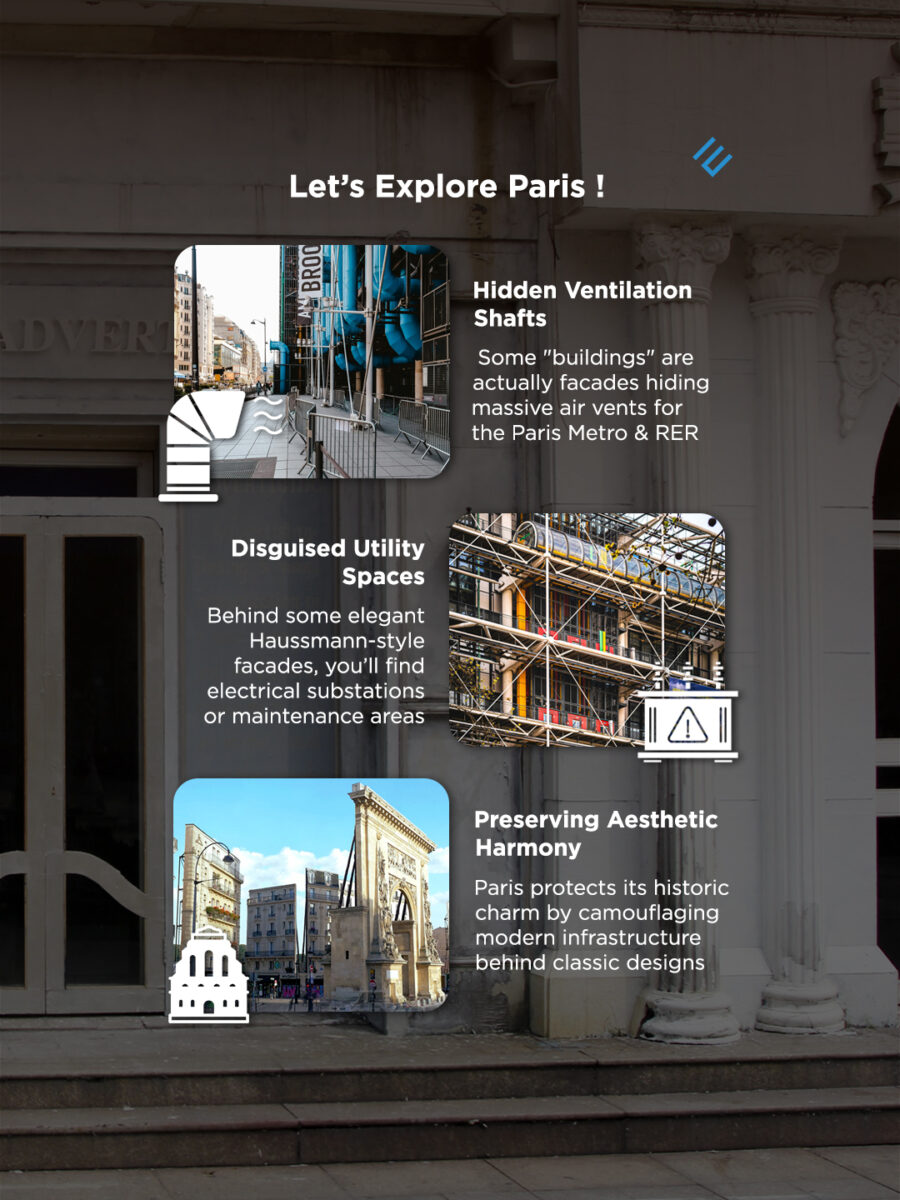
Hidden Ventilation Shafts
The Invisible Infrastructure
Beneath Paris lies a vast network of tunnels belonging to the Paris Metro and the RER. These underground systems require extensive ventilation to regulate airflow, temperature, and safety.
Large ventilation shafts are essential—but visually disruptive.
Rather than installing exposed industrial structures, the city chose a different solution: disguise them.
Buildings That Aren’t What They Seem
Some structures that appear to be residential or office buildings are actually carefully crafted facades hiding enormous air vents. From the street, they look like elegant Haussmann-style properties. Windows, balconies, and decorative details are replicated perfectly.
But behind those windows?
No apartments. No offices.
Just ventilation systems quietly serving millions of commuters.
It’s a brilliant compromise—modern engineering concealed within historic aesthetics.
Disguised Utility Spaces
Infrastructure in Disguise
Ventilation shafts aren’t the only hidden structures. In certain neighborhoods, what appears to be a grand residential building may actually house:
Electrical substations
Maintenance facilities
Utility control rooms
Instead of constructing obvious industrial facilities, Paris integrates them seamlessly into the urban fabric.
Why Go to Such Lengths?
Many cities accept visible utility structures as part of urban reality. Paris, however, treats its skyline and streetscape almost like a curated museum.
Behind elegant facades that mirror surrounding buildings, modern infrastructure hums quietly—ensuring electricity, transit, and public services function smoothly without disrupting visual continuity.
It’s architectural camouflage at its finest.

Preserving Aesthetic Harmony
A Commitment to Historic Identity
Paris is one of the world’s most photographed cities. Tourism plays a central role in its economy, and much of that appeal lies in its consistent architectural character.
If large industrial vents or exposed mechanical systems punctured the skyline, the visual rhythm of the city would change dramatically.
By camouflaging modern infrastructure behind classic designs, Paris protects its identity.
The Psychology of Urban Beauty
There’s also a psychological element. Walking through Paris feels immersive because the visual language remains consistent. The repetition of Haussmann facades creates a sense of calm and order.
Hidden infrastructure ensures that practical necessities do not interrupt that experience.
In other words, Paris prioritizes not just function—but feeling.
A City That Balances Past and Present
Not Everything Is as It Appears
The concept of “fake buildings” might sound deceptive—but in Paris, it’s a form of respect. It acknowledges the need for modern systems while honoring the city’s architectural heritage.
The infrastructure is real.
The facade is historic.
The illusion is intentional.
Lessons in Urban Design
Paris demonstrates that cities do not have to choose between progress and preservation. With thoughtful planning, they can integrate both.
Rather than erasing the past or exposing raw modernism, Paris wraps innovation in tradition.
It’s a reminder that cities, like people, can evolve without losing their character.
The Magic of What You Don’t See
The next time you stroll through Paris and admire its elegant buildings, remember: some of them may not be what they seem.
Behind those symmetrical windows could be roaring air systems for underground trains. Behind ornate stonework could be electrical grids powering the city.
But that’s part of the magic.
Paris teaches us that beauty can coexist with practicality—and that sometimes, the most impressive design is the one you never notice.
In a world where modern infrastructure often dominates skylines, Paris chooses subtlety. It chooses harmony. It chooses to let its history remain uninterrupted—even when the future is running quietly behind the walls.
And perhaps that’s why the city feels timeless.
Because in Paris, even the “fake” buildings are part of something very real:
A commitment to elegance, identity, and the art of thoughtful design.