
Beyond the Tourist Trail | Cultural Experiences You Can’t Miss
February 5, 2026
DISCOVER Kyoto’s Quiet Beauty in January
February 10, 2026Celebrating New Beginnings Across the Globe
The arrival of a new year is more than just a change on the calendar. It is a shared moment of hope, reflection, and renewal—one that unfolds differently across the world. As midnight travels from east to west, cities and cultures welcome the new year in their own unforgettable ways, blending tradition, spectacle, and collective joy.
From dazzling fireworks that light up iconic skylines to deeply spiritual rituals rooted in centuries-old beliefs, New Year celebrations reveal how humanity marks fresh beginnings with meaning and wonder. As 2025 approaches, the world once again becomes a stage for extraordinary moments—each destination offering a unique way to toast the future.
Here are three remarkable places where the world welcomes the New Year, each with its own rhythm, story, and spirit.

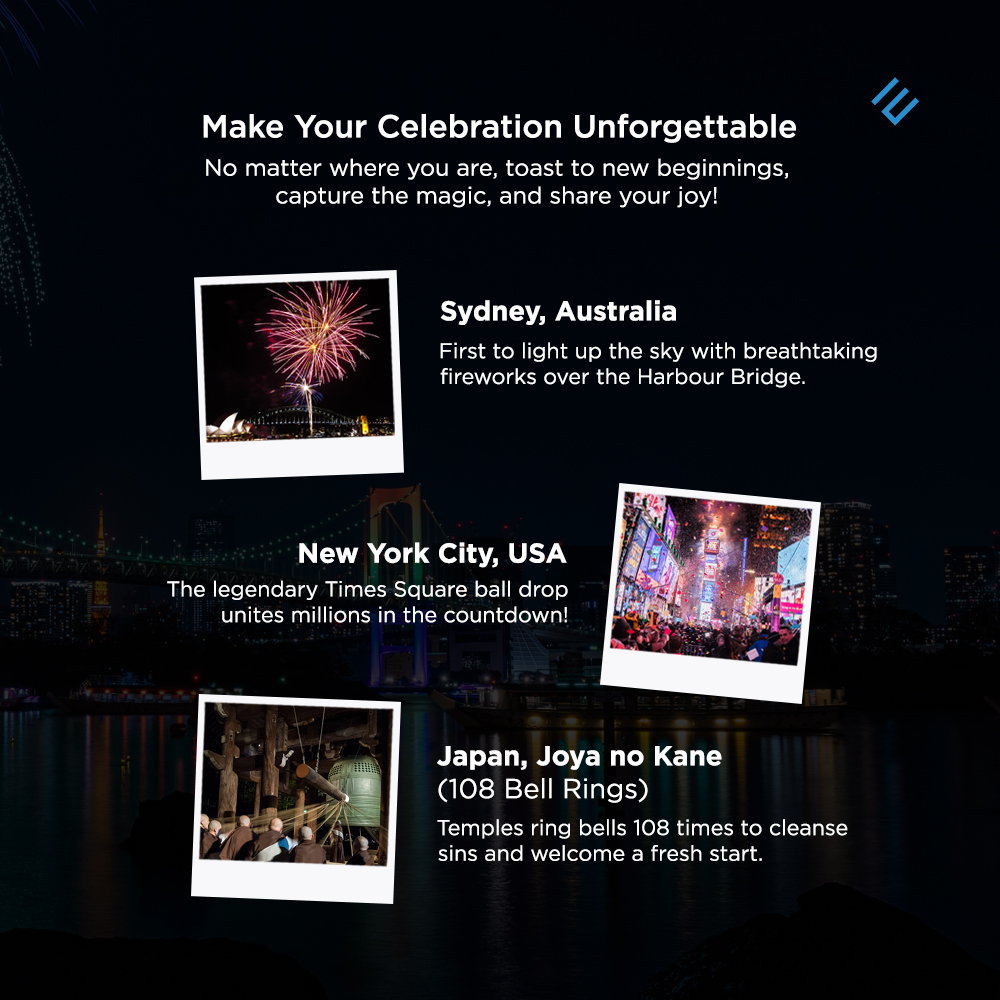
Sydney, Australia - First to Light Up the Sky with Breathtaking Fireworks over the Harbour Bridge
There are few places on Earth where the future arrives earlier than in Sydney. As one of the first major cities to cross into the New Year, Sydney holds a symbolic role—becoming the opening chapter of the world’s annual renewal. Long before midnight echoes elsewhere, Sydney has already stepped forward, carrying with it anticipation, optimism, and light.
The city’s geography plays a powerful role in shaping this experience. Built around a vast natural harbour, Sydney feels open and expansive, its skyline framed by water rather than walls. On New Year’s Eve, this openness becomes the perfect canvas for celebration. As darkness settles, the city gathers—quietly at first, then with rising energy—awaiting the moment when time officially turns.
At the heart of this transformation stands the Sydney Harbour Bridge, an architectural giant that becomes the focal point of one of the world’s most iconic fireworks displays. When midnight strikes, the bridge erupts in light. Fireworks arc across the sky in carefully choreographed sequences, cascading over the harbour and reflecting on the water below. Each burst feels deliberate, celebratory, and deeply symbolic.
But Sydney’s New Year’s Eve is not only about spectacle. It is about presence. Hours before the countdown, people gather along waterfronts, parks, and elevated lookouts. Conversations unfold, meals are shared, and strangers become companions in anticipation. There is a collective stillness just before midnight—a pause that feels almost sacred—before the sky ignites and the city exhales into the New Year.
Nearby, the Sydney Opera House glows beneath the fireworks, its sail-like silhouette anchoring the scene. Together, bridge and opera house form a visual language understood worldwide, instantly recognizable as a symbol of celebration, culture, and forward motion.
What makes welcoming the New Year in Sydney so meaningful is its emotional clarity. There is little irony here, little cynicism. The celebration feels sincere. Being among the first to enter a new year carries a quiet responsibility—to hope first, to imagine first, to begin again without hesitation.
As the final fireworks fade and the city settles into the early hours of January 1st, Sydney does not rush forward. Instead, it lingers in the afterglow—soft light on water, tired smiles, and the shared sense that something new has truly begun. It is not just a celebration of time, but a celebration of possibility.
New York City, USA The Legendary Times Square Ball Drop That Unites Millions
If Sydney opens the New Year, New York City defines it. Loud, emotional, crowded, and deeply symbolic, New York’s New Year’s Eve celebration is less about being first and more about being together. Here, the countdown is not simply observed—it is felt.
Every December 31st, the world’s attention gravitates toward Times Square, a crossroads of light, movement, and meaning. By late afternoon, the streets are already filled. People arrive layered in winter coats, carrying snacks, flags, and cameras, prepared to wait for hours just to witness a single moment.
The famous crystal ball—descending slowly as midnight approaches—has become one of the most powerful symbols of transition in modern culture. As it begins its final descent, the crowd counts together, voices merging into a single rhythm. In that moment, differences dissolve. Millions of individuals become one collective heartbeat.
When the clock strikes midnight, the city erupts. Confetti rains down, cheers echo between skyscrapers, and strangers embrace as if they have known each other forever. It is chaotic, overwhelming, and undeniably human. This is New York at its most honest—raw emotion layered over relentless energy.
What makes New York’s celebration so resonant is its inclusivity. People from every background, language, and belief system stand together, united not by tradition or ritual, but by shared anticipation. The ball drop is not ancient, yet it feels timeless because it speaks to something universal: the desire to mark change together.
Beyond Times Square, the city celebrates in quieter ways. Rooftop gatherings overlook glowing skylines. Jazz clubs welcome the year with music. Families toast at home, watching the countdown unfold on screens. Yet no matter where one stands, the pulse of the city remains unmistakable.
New York’s New Year’s Eve is not reflective like Japan’s, nor serene like Sydney’s afterglow. It is intense, emotional, and deeply collective. It reminds us that beginnings do not have to be quiet to be meaningful. Sometimes, they arrive loudly—carried by millions of voices counting down toward the same hope.
Japan, Joyanokane 108 Bell Rings to Cleanse the Past and Welcome a Fresh Start
In Japan, the New Year does not arrive with fireworks or countdowns. Instead, it arrives with sound—slow, resonant, and deeply intentional. Known as Joyanokane, this ancient Buddhist tradition offers a radically different way to cross the threshold into a new year.
As December 31st draws to a close, temples across Japan prepare for the ringing of bells—108 times in total. Each toll represents one of the earthly desires or negative emotions believed to cause human suffering: anger, jealousy, attachment, pride. The act of ringing the bell is not celebratory in the conventional sense; it is purifying.
The atmosphere surrounding Joyanokane is quiet and reverent. People gather in temple courtyards, often in winter silence, listening as the bell’s deep vibration travels through the air and into the body. There is no rush, no countdown shouted into the night. Time slows, allowing space for reflection.
What makes this ritual so powerful is its honesty. Rather than ignoring the burdens of the past year, Joyanokane acknowledges them. Each bell ring is an invitation to let go—not forcefully, but gently. By the final toll, the New Year arrives not as an explosion of excitement, but as a calm breath taken after release.
For travelers, witnessing Joyanokane can be profoundly moving. It reframes the idea of celebration, reminding us that renewal does not always require spectacle. Sometimes, it requires silence. Sometimes, it requires listening.
This tradition reflects a broader cultural philosophy in Japan—one that values balance, awareness, and intention. The New Year is not simply a new beginning; it is a continuation shaped by mindfulness.
As the final bell fades and the calendar turns, there is a sense of quiet rebirth. The world does not change instantly, but something internal does. And for many, that shift feels more lasting than any firework display.
Reflection
From Sydney’s radiant sky to New York’s unified countdown, and Japan’s soulful bells, the New Year reveals itself in many forms. Each destination offers a different answer to the same question: How do we begin again?
Some begin with light.
Some begin with voices.
Some begin with silence.
And in that diversity lies the beauty of travel—an opportunity not just to witness celebration, but to choose the meaning with which we welcome the year ahead.
